
e-Warehouse - Introduction to warehouse management
🎯 Learning objectives
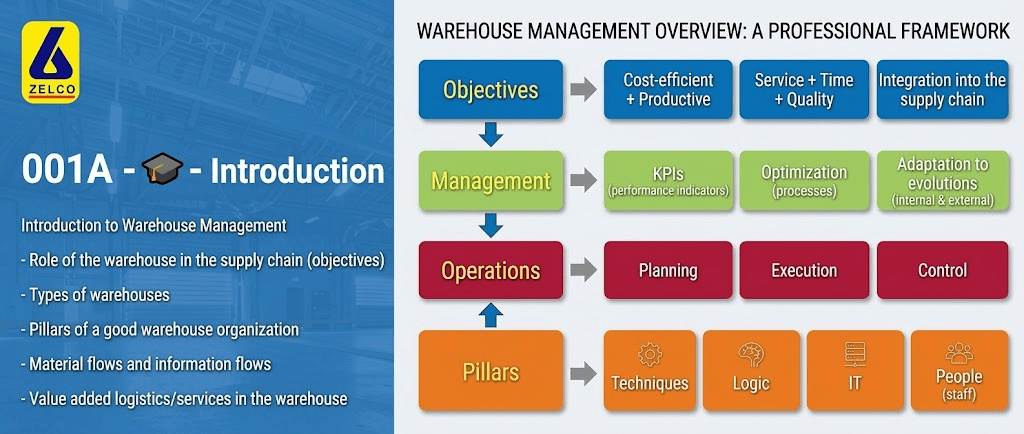
The aim of this introduction is to give you a clear understanding of the whole landscape:
1. Role in the supply chain & warehouse types
- Position & types: Warehouse functions from raw materials to the end customer. Distinguish between production warehouses (raw materials, WIP and spare parts), distribution warehouses (B2B, B2C/e-commerce and hubs) and retail warehouses (counter service and self-service).
- Organisational models: In-house operations versus outsourcing (public, ADR and dedicated), conventional (Man-to-Goods) versus automated (Goods-to-Man), direct versus indirect issuing, and open versus closed warehouse management.
2. Objectives & integrated management
- Multiple objectives & costs: Balance business interests (costs and efficiency) with customer service (time and quality). Manage storage-space costs versus handling costs.
- Trade-offs & integration: Storage density versus movement, service levels versus productivity, and alignment with purchasing, production, transport and sales.
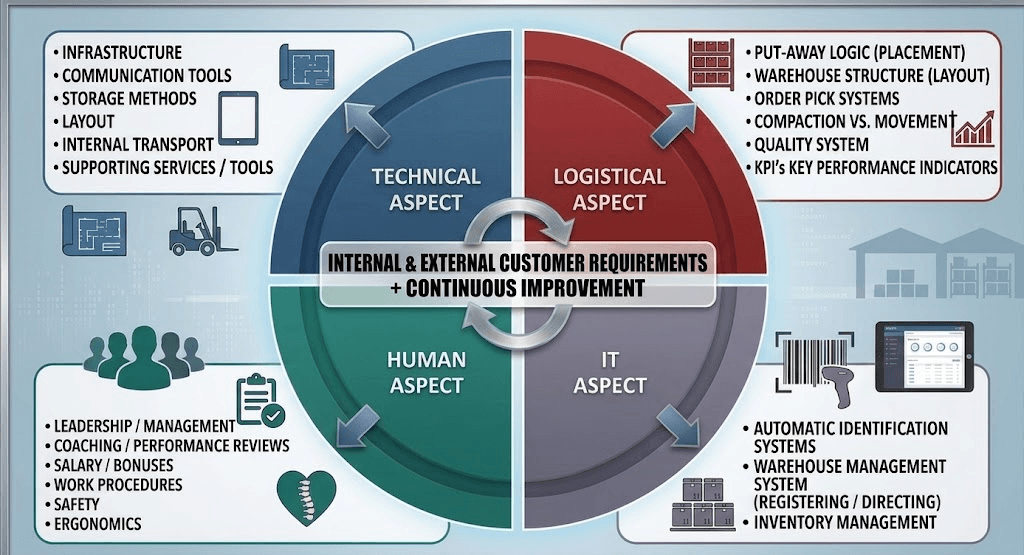
3. The four pillars of warehouse organisation
- Technology: Storage, transport and communication equipment.
- Logic: Layout, ABC analyses, put-away and picking routes.
- IT: Control and recording through the WMS.
- People: Safety, ergonomics, leadership, training, and the use of permanent versus temporary staff.
4. Flows & IT/OT automation
- Goods & information flows: Inbound and outbound processes linked to paperless, real-time data systems.
- IT/OT hierarchy: The IT layer (ERP/WMS: what), the WCS/MES layer (route) and the OT layer (PLCs controlling conveyors, AS/RS, AGVs and sorters).
5. Tactical management: KPIs & development
- KPIs: SMART/KISS indicators divided into primary indicators (service levels, costs and productivity) and secondary indicators (occupancy, picking lines and energy).
- Improvement & agility: Continuous Improvement versus Quantum Leap projects, such as a WMS implementation, and adaptation to changing market conditions.
6. Belgian compliance & VAL/VAS
- Compliance: Well-being at work / Codex (ergonomics and EDTC/Vinçotte inspections), environment / VLAREM (ADR/PGS), FAVV (HACCP), customs (AEO) and social legislation (temporary agency work and night work).
- VAL/VAS: VAS for information/services (Track & Trace, labelling and VMI) and VAL for physical operations (kitting, packaging, assembly/disassembly, returns and display construction).
These topics are explored in full detail in later modules.
