
1. Warehouse organisation & control
  2. Courses

e-Warehouse - Order picking & Dispatch
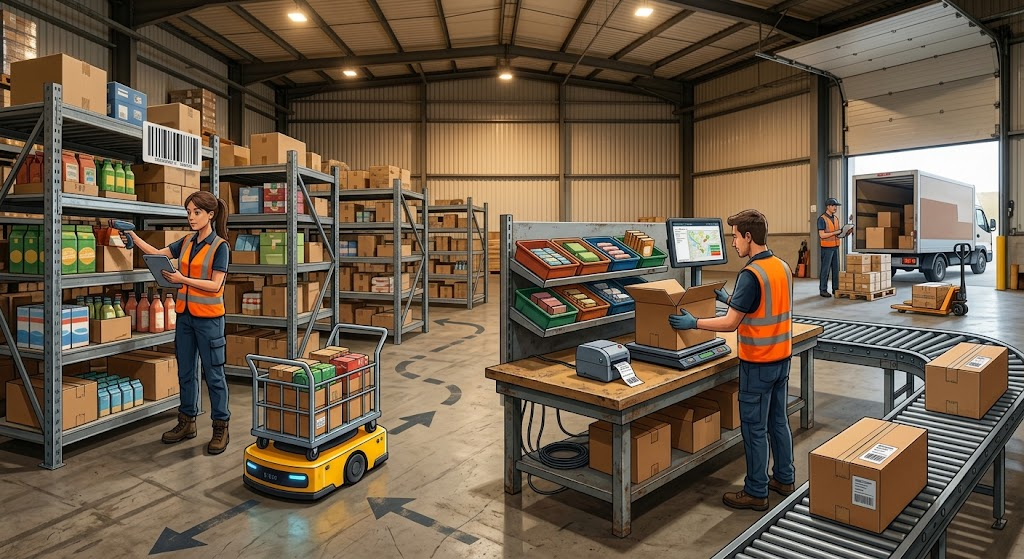
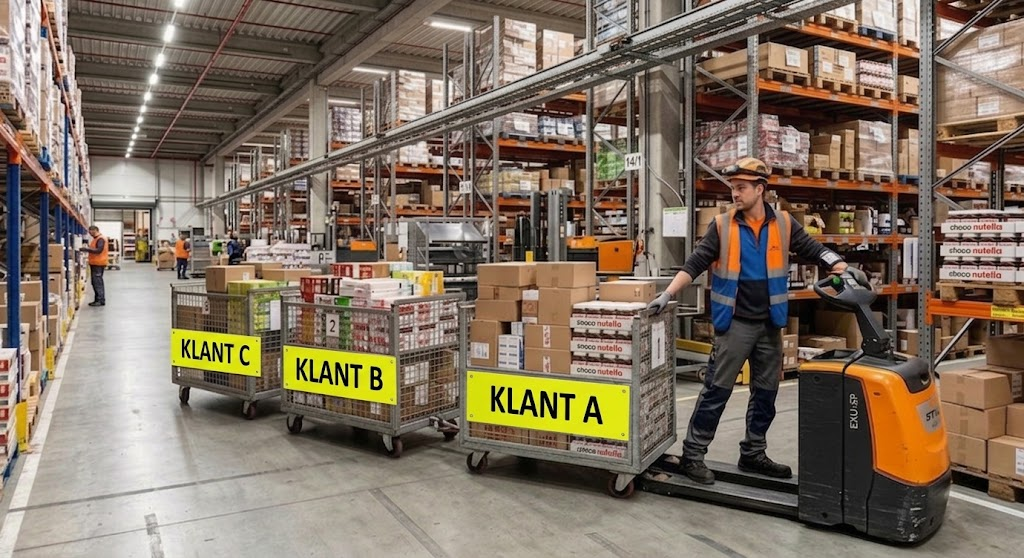
The Order picking & dispatch module teaches you how to organise the entire warehouse outbound process efficiently, accurately and with costs in mind. In Order picking, you will discover how intelligent order analysis (EQN), appropriate picking strategies such as batch, zone or swarm picking, and optimal routing can drastically reduce travel times. In Dispatch, you will learn to consolidate, pack, check and safely load goods professionally in accordance with applicable transport and legislative standards.

Standalone module

e-Warehouse - Order picking & Dispatch
e-Warehouse - Order picking & Dispatch
e-Warehouse - Order picking & Dispatch
e-Warehouse - Order picking & Dispatch

e-Warehouse - Order picking & Dispatch

e-Warehouse - Order picking & Dispatch

🎯 Learning objectives

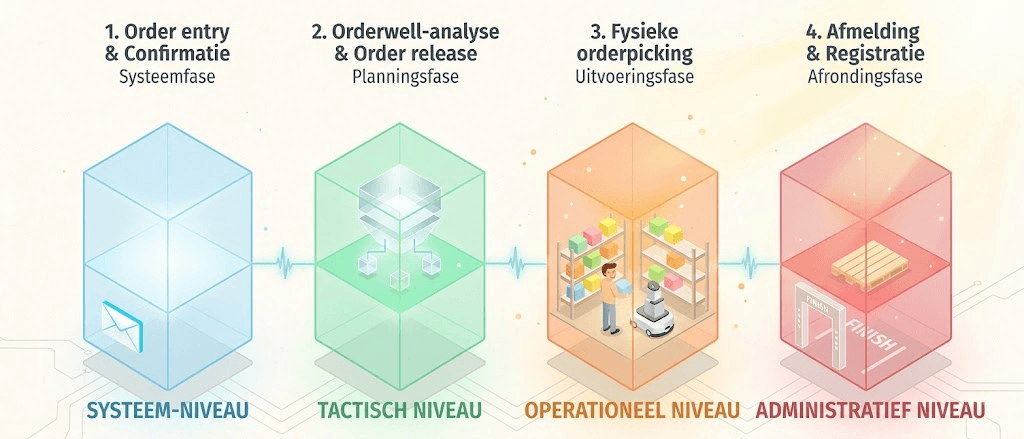
After successfully completing this course, you will be able to independently streamline the entire outbound logistics process, from initial order entry to physical handover to the carrier:

1. Order & data analysis (EQN method)

  • Carry out quantitative order analyses: Analyse raw order data using the EQN method.
  • Determine order profiles and warehouse zoning: Translate key figures into specific order profiles and warehouse zones, such as Single-Item, Multi-Item and Bulk/Pallet Picking.
  • Reduce walking distances: Understand the crucial role of the order line as a driver of physical movement, and apply ABC analyses and slotting strategies to minimise non-value-added time.

2. Picking strategies, routing & WMS control

  • Select & apply picking strategies: Weigh the advantages and disadvantages of Discrete Order Picking, Batch Picking, Group/Cluster Picking, Two-Step Picking, Zone Picking and advanced methods such as Swarm Picking using AMRs.
  • Evaluate static versus dynamic approaches: Make informed choices between Picker-to-Goods (dynamic) and Goods-to-Picker (static/AS-RS), based on CAPEX, OPEX, lead time and flexibility.
  • Use WMS control mechanisms: Understand how a WMS balances workloads through Wave Management, job generation and Task Interleaving.
  • Apply routing patterns: Determine the optimal walking route (I-routing, U-routing or Z-routing) based on order density and aisle width.

3. Information flows & shop-floor technology

  • Use communication technologies: Select suitable identification and communication tools, such as RF handheld scanners, Voice Picking, Pick/Put-to-Light, Smart Glasses/AR and RFID, based on accuracy, speed and ergonomics.
  • Analyse the structure of picking documents: Understand how location codes and picking data should be structured to avoid search time and errors.

4. Consolidation, packaging & quality control

  • Apply consolidation logic: Know how and when to combine partial orders based on order, customer, transport, time or product criteria, such as ADR or chilled goods.
  • Organise consolidation techniques: Choose the right place and time for consolidation.
  • Pack & identify goods: Select suitable secondary and tertiary packaging, understand box-sizing calculations, and know how to apply SSCC transport labels and customer-specific labels.
  • Final checks & quality gates: Set up physical and administrative checkpoints for order completeness, weight checks, lot-number traceability and the generation of Advance Shipping Notices (ASN).

5. Outbound transport, loading & legislation

  • Transport preparation & load plans: Prepare efficient load plans that account for delivery sequence, centre of gravity, load stability and maximum load utilisation.
  • Load securing & legislation: Apply the basic rules of load securing, using lashing straps, anti-slip mats and shoring bars, and ensure that the maximum authorised mass (MTM) and maximum axle loads are not exceeded.
  • Dock & yard management: Understand docking safety procedures and infrastructure, including Powerlock/Wheel-lok, dock levellers and dock shelters, and the management of dock occupancy.
  • Manage document flows: Know the purpose and requirements of essential transport documents, including the CMR consignment note, packing lists, POD (Proof of Delivery) and ADR documents.

6. KPI monitoring & continuous improvement (Lean)

  • Measure & manage performance: Calculate, analyse and report critical KPIs such as OTIF (On Time, In Full), Pick Accuracy, Order Accuracy, Perfect Order Rate and Dock-to-Ship Time to continually optimise the process through Kaizen/Lean.


What is included in this product?

Standalone module

This product contains 5 e-learning modules. You complete the modules at your own pace.

Access available after purchase.

  • 005B 🎦 Order processing
  • 005C 🎦 Order picking methods
  • 005A 🎓 Order Picking
  • 006A 🎓 Shipping
  • Warehouse case study D.05 ✏️ Order picking (quiz)

Training several employees?

Would you like to purchase courses for a team or several employees? We would be happy to discuss a solution tailored to your organisation.

Request employee training

Frequently asked questions

  • Each course and workshop clearly states the required entry level and any specific prior knowledge needed. Unsure which level best matches your experience? Feel free to contact us for advice.

    Contact us

  • Yes. After successfully completing an online course or attending a workshop, you will receive an official Certificate of Participation, which you can add to your CV or LinkedIn profile.

  • Yes. Contact us as soon as possible and include your name and the course you registered for. You can find the applicable cancellation terms on the course page.

  • Once your registration has been processed, you will receive a personal login link and practical information by email to help you get started.

    Tip: Haven’t received an email? Check your junk or spam folder, just in case.

  • Go to the page of the course you would like to take and click ‘Register’. Fill in the form with your details and complete your registration. You will receive a confirmation email with all the details immediately afterwards.

  • The requirements are listed on the workshop page and in your confirmation email. In most cases, you only need to bring your confirmation and, if needed, a laptop.

  • Yes, you can. However, you will need to complete a separate registration form for each participant.

    If you would like to register a larger group or are looking for tailored training at your own premises, there is an easier option! Contact us to discuss the possibilities for an in-company workshop.

  • Go to the workshop page, choose an available date and click ‘Register’. After entering your details, you will receive a confirmation by email.

  • Depending on your sector, region and type of organisation, our courses and consulting programmes qualify for specific training subsidies, such as KMO-portefeuille. Contact us or your contact person at your sector organisation (Cevora, Alimento, etc.) to explore the options available to your company.

    Contact us

  • You can pay directly and securely online, including by iDEAL, Bancontact or credit card. For business registrations, you can also request an invoice in advance and pay it within the agreed payment period. Select the appropriate option when placing your order for each course.

  • Yes, absolutely. Almost all our workshops and training courses can be fully tailored to the specific processes and situations within your organisation. Contact us to discuss the possibilities.

    Contact us

  • Our consulting service always starts with an initial consultation without obligation, during which we identify your specific logistics challenges and objectives. We then draw up a clear action plan and a suitable quotation.

    More about logistics consulting