
1. Warehouse organisation & control
  2. Warehouse layout & design
  3. Courses

e-Warehouse - Layout & Design
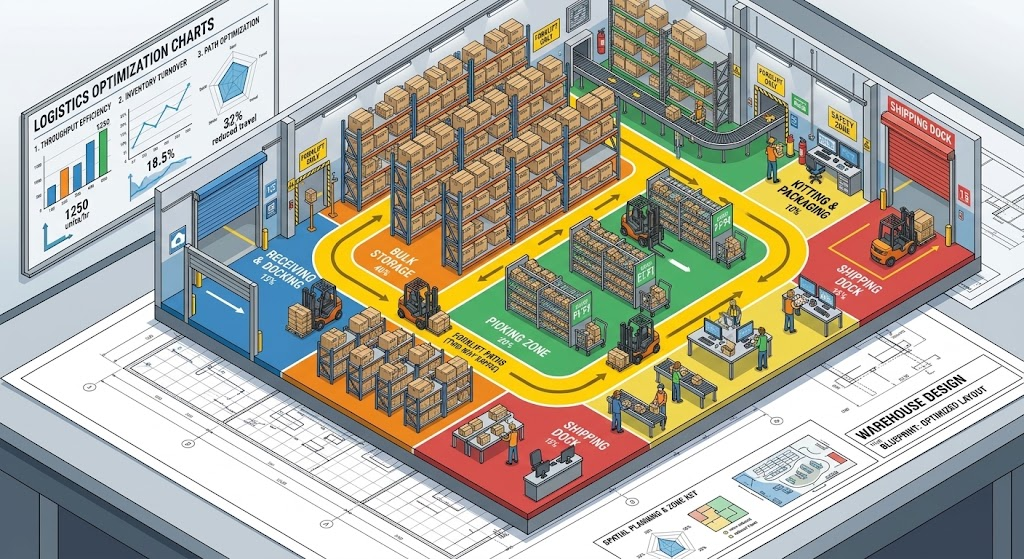
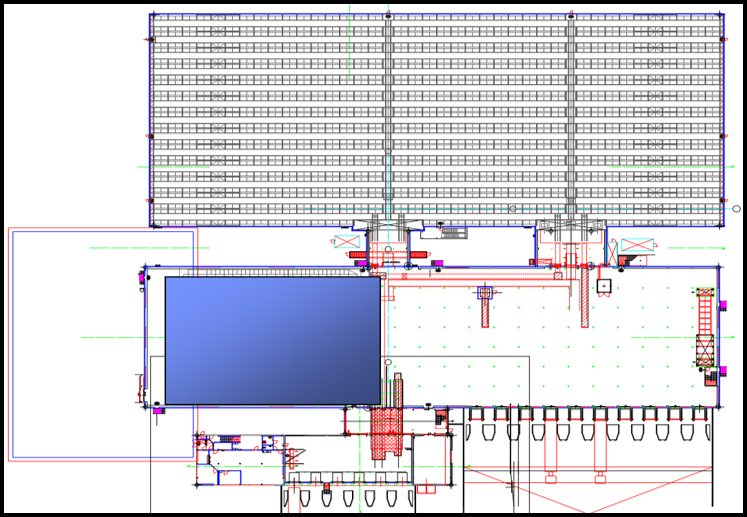
These e-learning modules form a streamlined, practical learning path in data-driven warehouse layout and optimisation. In Data Analysis as the Foundation of Warehouse Layout and the in-depth ABC/Pareto analysis instructional video, participants learn to analyse large datasets to categorise items as A, B or C and minimise movement and walking distances in the warehouse. Warehouse Layout & Design Methods then introduces the proven SHA (Systematic Handling Analysis) and SLP (Systematic Layout Planning) methods to map goods flows visually, calculate transport work and develop efficient layouts. Finally, the instructional video on configuring and sizing storage space brings these theoretical principles together in a concrete practical case. This e-learning package equips participants with immediately applicable skills to independently analyse, restructure and optimise logistics spaces for maximum operational efficiency.

Standalone module

e-Warehouse - Layout & Design

e-Warehouse - Layout & Design

e-Warehouse - Layout & Design

🎯 Learning objectives

After completing this self-study package, participants will be able to:

  • Analyse & apply logistics data: Understand and apply the Pareto principle (20/80 rule) and ABC analysis to warehouse data, such as order lines and inventory turnover, to allocate items efficiently and minimise walking distances.
  • Use a structured analytical approach: Apply the PQRST key (Products, Quantity, Route, Service, Time) as a checklist for analysing and preparing reconfiguration or design projects.
  • Quantify goods flows & transport work: Map goods flows using flow charts and From-To matrices, and calculate current transport work (Distance × Intensity) to evaluate layout efficiency.
  • Apply systematic layout methods: Follow the steps of SHA (Systematic Handling Analysis) and SLP (Systematic Layout Planning) to substantiate both zone improvements and complete designs, including new-build projects.
  • Assess & compare layout alternatives: Prepare space-requirement analyses (Area Lists) and affinity diagrams (space-relationship diagrams), and compare alternative layouts objectively using weighted evaluation matrices and budget considerations.
  • Make practical warehouse fit-out decisions: Integrate physical and structural constraints, such as aisle widths, safety zones and loading-dock infrastructure, into a detailed, functional warehouse design.


What is included in this product?

Standalone module

This product contains 11 e-learning modules. You complete the modules at your own pace.

Access available after purchase.

  • 010A 🎓 Data analysis as the foundation of warehouse layout
  • 010B 🎦 ABC analysis (20/80 rule)
  • 013A 🎓 Warehouse Layout & Design Methodology
  • 013B 🎓 Structural elements & Quay infrastructure
  • 013C 🎦 Storage sizing and layout (practical case)
  • 009A 🎓 Management of information flows
  • Warehouse Case Study D.02 ✏️ Warehouse Techniques (quiz)
  • Warehouse case study D.06 ✏️ Communication methods (quiz)
  • Warehouse case study D.08 ✏️ Packaging (quiz)
  • Warehouse case study D.12 ✏️ Layout (quiz)
  • Warehouse case D.17 ✏️ Warehouse audit

Training several employees?

Would you like to purchase courses for a team or several employees? We would be happy to discuss a solution tailored to your organisation.

Request employee training

Frequently asked questions

  • Each course and workshop clearly states the required entry level and any specific prior knowledge needed. Unsure which level best matches your experience? Feel free to contact us for advice.

    Contact us

  • Yes. After successfully completing an online course or attending a workshop, you will receive an official Certificate of Participation, which you can add to your CV or LinkedIn profile.

  • Yes. Contact us as soon as possible and include your name and the course you registered for. You can find the applicable cancellation terms on the course page.

  • Once your registration has been processed, you will receive a personal login link and practical information by email to help you get started.

    Tip: Haven’t received an email? Check your junk or spam folder, just in case.

  • Go to the page of the course you would like to take and click ‘Register’. Fill in the form with your details and complete your registration. You will receive a confirmation email with all the details immediately afterwards.

  • The requirements are listed on the workshop page and in your confirmation email. In most cases, you only need to bring your confirmation and, if needed, a laptop.

  • Yes, you can. However, you will need to complete a separate registration form for each participant.

    If you would like to register a larger group or are looking for tailored training at your own premises, there is an easier option! Contact us to discuss the possibilities for an in-company workshop.

  • Go to the workshop page, choose an available date and click ‘Register’. After entering your details, you will receive a confirmation by email.

  • Depending on your sector, region and type of organisation, our courses and consulting programmes qualify for specific training subsidies, such as KMO-portefeuille. Contact us or your contact person at your sector organisation (Cevora, Alimento, etc.) to explore the options available to your company.

    Contact us

  • You can pay directly and securely online, including by iDEAL, Bancontact or credit card. For business registrations, you can also request an invoice in advance and pay it within the agreed payment period. Select the appropriate option when placing your order for each course.

  • Yes, absolutely. Almost all our workshops and training courses can be fully tailored to the specific processes and situations within your organisation. Contact us to discuss the possibilities.

    Contact us

  • Our consulting service always starts with an initial consultation without obligation, during which we identify your specific logistics challenges and objectives. We then draw up a clear action plan and a suitable quotation.

    More about logistics consulting